
42AI × NVIDIA · Research
From Behavioral Knowledge to Behavioral Prediction
Building 42AI's Large Behavioral Models with NVIDIA Nemotron
How behavioral context, targeted fine-tuning, and model-specific training recipes turn compact foundation models into predictors of human actions.
People facing the same situation do not necessarily make the same decision.
In trading, two traders can see the same market conditions and respond differently. Their recent experiences, established habits, current circumstances, and tolerance for uncertainty can all matter.
At 42AI, we are building Large Behavioral Models—LBMs—to connect this context to measurable predictions of human behavior. Our approach brings trader history, current state, and behavioral information into a structured language representation, then adapts a foundation model to a specific prediction task.
NVIDIA Nemotron has shown particular strengths in this process: recognizing behavioral patterns, learning useful task behavior from relatively few labeled examples, and producing strong predictions after the training recipe is refined.
Our evaluation includes other open-weight foundation models, classical machine-learning methods, and API models. The interesting findings are not a single overall ranking. They are the places where Nemotron's capabilities translate into an advantage—and the engineering work needed to make that happen.
Part 01
Choose the foundation model for the behavioral skills that matter
Before teaching a model to predict an action, we examined what it already understood about behavior.
Our definition-blind knowledge battery covers 32 behavioral constructs. It tests conceptual knowledge, behavioral manifestations, recognition from examples, and distinctions between easily confused constructs. The models do not receive our official definitions before answering. Fixed-answer questions are scored mechanically; free-text responses are graded against predefined rubrics.
That design separates two capabilities that are often grouped together: recognizing a pattern and explaining it.
In the model-selection snapshot used for our NVIDIA review, the selected subtest results were:
Behavioral knowledge battery
Selected subtests, by base model
- Behavioral-vignette accuracy
- Boundary-explanation rubric score
Nemotron 3 Nano 4B
Nemotron 3.5 Lightning 30B-A3B
Qwen 3.5 4B
Qwen 3.5 9B
Llama 3.1 8B
Qwen 3.5 2B
Gemma 1.1 7B
Qwen 3.5 0.8B
Gemma 1.1 2B
Show data
| Base model | Behavioral-vignette accuracy | Boundary-explanation rubric score |
|---|---|---|
| Nemotron 3 Nano 4B | 74.8% | 66.1% |
| Nemotron 3.5 Lightning 30B-A3B | 70.9% | 79.0% |
| Qwen 3.5 4B | 49.6% | 78.0% |
| Qwen 3.5 9B | 75.2% | 83.0% |
| Llama 3.1 8B | 63.5% | 52.5% |
| Qwen 3.5 2B | 67.0% | 50.1% |
| Gemma 1.1 7B | 45.2% | 46.3% |
| Qwen 3.5 0.8B | 59.6% | 31.8% |
| Gemma 1.1 2B | 48.7% | 24.9% |
Selected subtests from a broader open-weight model evaluation are shown here. Additional models were evaluated, with relative performance varying by subtest.
Vignette accuracy measures whether the model selects the construct supported by a short behavioral scenario. The explanation score measures the proportion of rubric points earned when distinguishing related constructs. They are different measurements, not interchangeable accuracy scores.
The vignette accuracy of Nemotron 3 Nano 4B (Nemotron 4B below) was 25.2 percentage points higher than Qwen 3.5 4B. Nemotron 3.5 Lightning 30B-A3B (Lightning below) showed a different profile: stronger explanations of conceptual boundaries, including a higher score than Qwen 3.5 4B.
These comparisons helped us identify capabilities relevant to an LBM without treating the overall knowledge-exam score as the only selection criterion. They did not establish that conceptual knowledge automatically causes better prediction. That required a separate test against observed trader behavior.
Part 02
Give the model a representation of the person and the situation
An LBM needs more than a generic instruction to predict what someone will do.
We construct a structured description from information available at the observation time: trader background, trading history, recent activity, current account context, behavioral scores, and relevant market information. The model receives these together with a clearly defined prediction question.
The language representation provides a common interface for different kinds of evidence. Numerical observations can appear alongside descriptions of habits and contextual information. Behavioral scores are part of that representation—not a claim that the model has independently diagnosed a trader's psychology.
For classification tasks, the output is deliberately narrow. Rather than asking for an essay and extracting a decision afterward, our training objective operates on the logits corresponding to the allowed answer digits. A softmax produces outcome scores, while class-weighted cross-entropy addresses the imbalance between common and uncommon events.
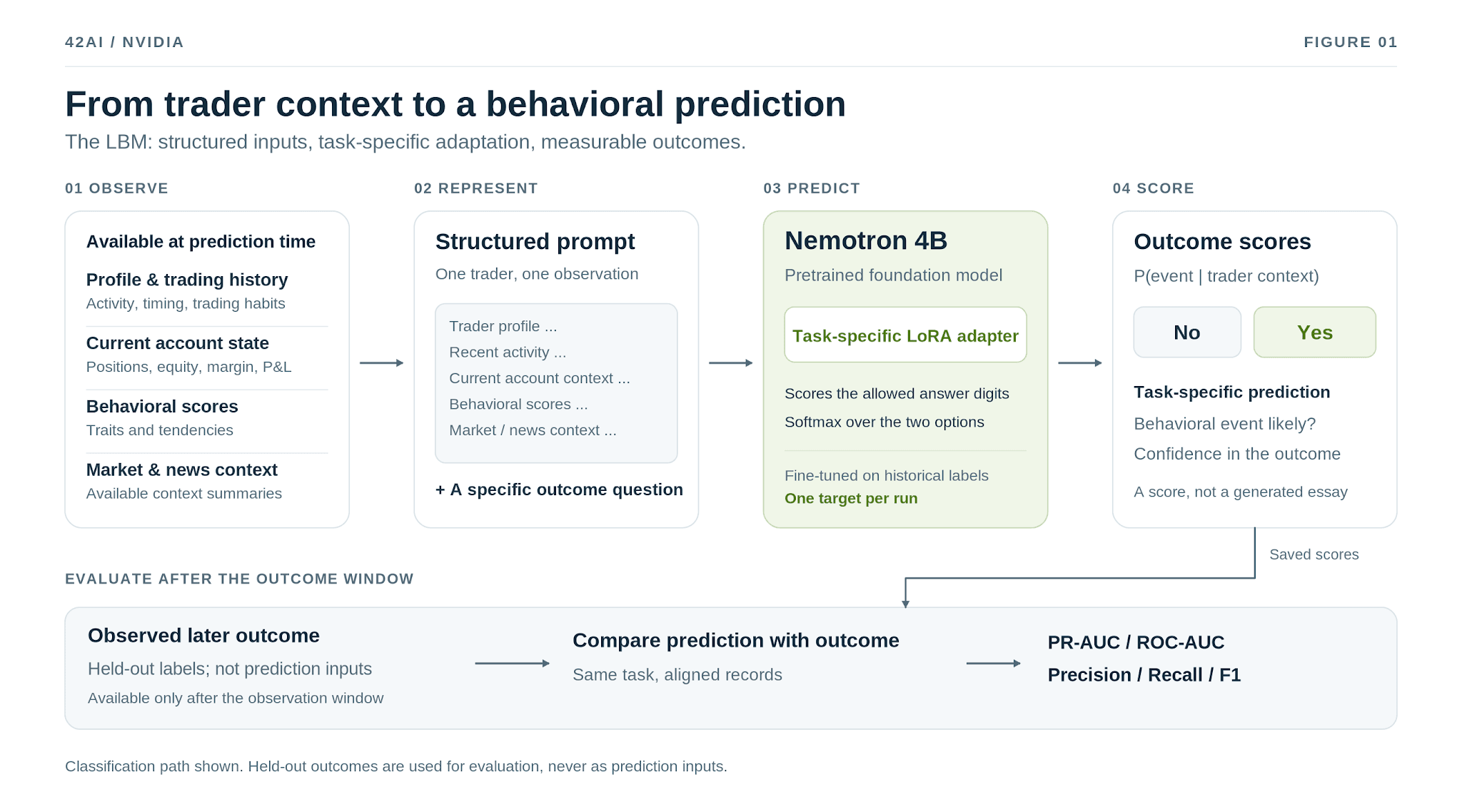
This separates two concerns: language is the representation; prediction is the objective. The resulting system can be evaluated using ranking metrics, precision, recall, and F1 rather than the plausibility of a generated explanation.
Part 03
A strong start with limited labeled data
The first downstream result that drew our attention came after only 2,000 training examples.
On an early development task, Nemotron 4B achieved 0.680 macro F1 after one epoch. Qwen 3.5 9B, the next-best tested open-weight model at this budget, reached 0.498, while several other models remained near the majority-class baseline.
Macro F1 after the same 2,000-example fine-tune
One epoch, same training rows
Nemotron 3 Nano 4B
Qwen 3.5 9B
Qwen 3.5 4B
Llama 3.1 8B
Majority-class baseline 0.488
Show data
| Base model, after the same 2,000-example fine-tune | Macro F1 |
|---|---|
| Nemotron 3 Nano 4B | 0.680 |
| Qwen 3.5 9B | 0.498 |
| Qwen 3.5 4B | 0.488 |
| Llama 3.1 8B | 0.488 |
| Majority-class baseline | 0.488 |
We also evaluated additional open-weight models not shown here; at the same 2,000-example budget, their macro F1 scores were lower than or similar to those listed.
These were supervised adaptation results, not zero-shot predictions. The comparison establishes an early macro-F1 advantage under the tested recipe; it does not imply that Nemotron led every metric or every later training budget.
For our development process, the result was useful. It showed that a compact model could begin learning the task before we committed to large training runs.
As the training set grew, Nemotron's macro F1 increased from 0.680 at 2,000 examples to 0.768 at 5,000 and 0.823 at 10,000. But at 25,000 examples, the one-epoch score remained approximately flat.
That apparent plateau led to one of the most valuable parts of the project.
Part 04
The plateau was a question about the recipe
Our initial recipe was intentionally simple: LoRA rank 16, alpha 32, dropout 0.05, AdamW, a peak learning rate of 5 × 10⁻⁵, cosine decay, 3% warmup, and an effective batch size of 16.
We applied one epoch at every training-set size.
When performance stopped improving, we discussed two possible explanations with NVIDIA: perhaps the task added little new information relative to pretraining, or perhaps the optimization schedule was not allowing the model to adapt sufficiently.
A sampled overlap check did not find direct overlap with the public post-training examples examined. A classical tabular benchmark provided another clue: it extracted more predictive signal from the same input columns than our initial Nemotron run. The inputs had not exhausted their usefulness.
We then tested longer training, lower learning rates, and a longer warmup.
More training helped—but not at every learning rate
Nemotron 4B, 25,000 examples
ROC-AUC and PR-AUC by training configuration
- ROC-AUC
- PR-AUC
One epoch, peak LR 5 × 10⁻⁵
Three epochs, peak LR 2 × 10⁻⁵
Three epochs, peak LR 2 × 10⁻⁵, longer warmup
Three epochs, peak LR 5 × 10⁻⁵
Show data
| Nemotron 4B configuration, 25,000 examples | ROC-AUC | PR-AUC |
|---|---|---|
| One epoch, peak LR 5 × 10⁻⁵ | 0.931 | 0.670 |
| Three epochs, peak LR 2 × 10⁻⁵ | 0.942 | 0.714 |
| Three epochs, peak LR 2 × 10⁻⁵, longer warmup | 0.939 | 0.712 |
| Three epochs, peak LR 5 × 10⁻⁵ | 0.982 | 0.793 |
The large improvement came from extending training while retaining the original peak learning rate. Lowering the learning rate did not reproduce it. A second seed of the original one-epoch configuration reached 0.935 ROC-AUC and 0.696 PR-AUC, still substantially below the successful three-epoch result.
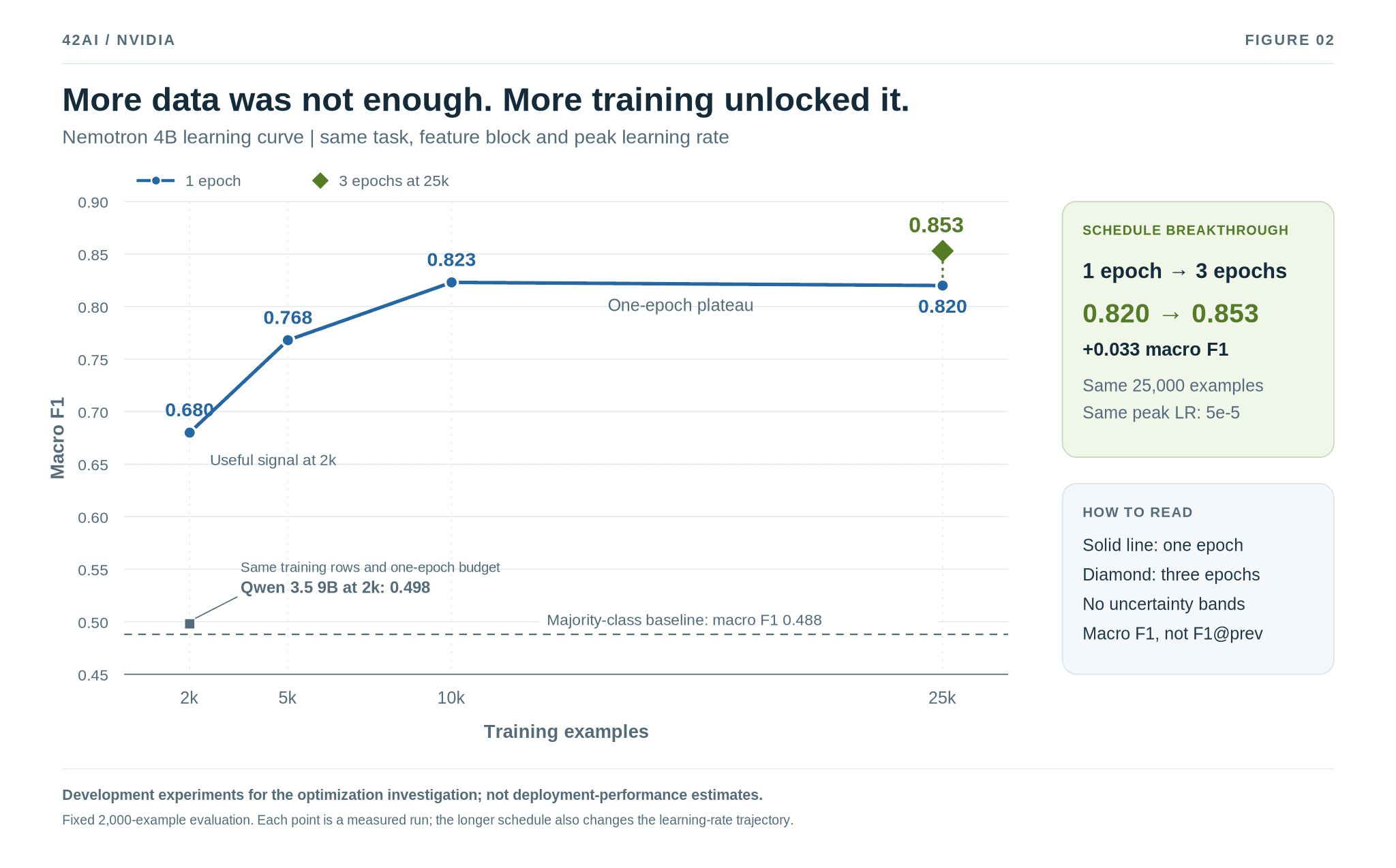
These development experiments explain the optimization investigation; they are not deployment-performance estimates and are separate from the updated evaluations in Sections 05 and 06.
The practical conclusion was important:
An apparent model ceiling can be the ceiling of the training recipe.
Extending a cosine schedule changes both the number of optimization steps and the learning-rate trajectory. We therefore interpreted the result as evidence of undertraining under the original schedule—not proof that epoch count alone explained the improvement.
Lightning benefited from architecture-specific settings
Nemotron Lightning reinforced the need to tune the recipe for the model rather than assuming one configuration would suit the entire family.
Using our structured-answer route, the original Lightning recipe improved when extended from one to three epochs. NVIDIA’s recommended recipe then reached nearly the same ROC-AUC in one epoch that the original recipe required three epochs to achieve.
Nemotron Lightning development configurations
ROC-AUC and PR-AUC by recipe and training budget
- ROC-AUC
- PR-AUC
Original recipe
10k examples × 1 epoch
Original recipe
10k examples × 3 epochs
NVIDIA-recommended recipe
10k examples × 1 epoch
NVIDIA-recommended recipe
25k examples × 3 epochs
Show data
| Lightning development configuration | Training budget | ROC-AUC | PR-AUC |
|---|---|---|---|
| Original recipe | 10k examples × 1 epoch | 0.8395 | 0.1835 |
| Original recipe | 10k examples × 3 epochs | 0.9335 | 0.5432 |
| NVIDIA-recommended recipe | 10k examples × 1 epoch | 0.9278 | 0.4906 |
| NVIDIA-recommended recipe | 25k examples × 3 epochs | 0.9852 | 0.8103 |
The recommended configuration used LoRA rank 8, alpha 32, a peak learning rate of 10⁻⁴, weight decay of 0.1, and cosine decay with a 10⁻⁵ floor. These are also development measurements, separate from the updated evaluations below. The final row changes both data volume and training duration, so their contributions cannot be isolated from that comparison alone.
Together, the experiments changed how we approached scaling: more data is useful only when the adaptation process can learn from it.
Part 05
Updated results: useful distinctions in trading behavior
Our updated evaluation covers several trader-behavior questions, including uncommon events. We refer to them here as Task A, Task B, and Task C, without disclosing their operational definitions.
Nemotron 4B produced the following results:
| Metric | Task A | Task B: rare event | Task C: rarer event |
|---|---|---|---|
| PR-AUC | 0.709 | 0.7378 | 0.5566 |
| ROC-AUC | 0.967 | 0.9779 | 0.9879 |
| Positive-class precision | 69.8% | 73.9% | 62.4% |
| Positive-class recall | 68.0% | 75.0% | 75.3% |
| Positive-class F1 | 0.689 | 0.7445 | 0.6824 |
| Parse errors | 0 | 0 | 0 |
Each task is evaluated on its defined population, so the three columns are not intended as a cross-task difficulty ranking.
Where Nemotron improved on Qwen 3.5 4B
On Task A, Nemotron recorded the highest positive-class F1 among the models in that comparison: 0.689 versus 0.683 for Qwen 3.5 4B, the next-best open-weight model in that comparison. The margin is small and remains a single-run observation.
Task B gives a more tangible view of the trade-off. Against the matched original Qwen 3.5 4B run:
Task B: matched comparison
Nemotron 3 Nano 4B vs. Qwen 3.5 4B at the reported decision thresholds
- Nemotron 3 Nano 4B
- Qwen 3.5 4B
Positive-class precision
Positive-class F1
Macro F1
Show data
| Task B outcome | Nemotron 3 Nano 4B | Qwen 3.5 4B |
|---|---|---|
| Positive-class precision | 73.9% | 65.4% |
| Positive-class F1 | 0.7445 | 0.7210 |
| Macro F1 | 0.8678 | 0.8551 |
Task B: false alarms
Nemotron 3 Nano 4B vs. Qwen 3.5 4B at the reported decision thresholds
- Nemotron 3 Nano 4B
- Qwen 3.5 4B
False alarms
Show data
| Task B outcome | Nemotron 3 Nano 4B | Qwen 3.5 4B |
|---|---|---|
| False alarms | 89 | 143 |
This is a matched comparison at the reported decision thresholds, not an exhaustive ranking of all tested prompts, seeds, and training configurations.
Nemotron generated 54 fewer false alarms—approximately 38% fewer. It detected 252 positive events, compared with 270 for Qwen 3.5 4B, so the precision improvement came with lower recall.
That distinction matters. Nemotron's advantage here is a useful operating-point result, not a claim that it dominates the entire precision–recall curve. Qwen 3.5 4B had higher ROC-AUC and PR-AUC.
For a workflow in which every flagged case requires attention, the difference between 89 and 143 false alarms can be operationally relevant. Whether that trade-off is preferable depends on the cost of missed events versus unnecessary interventions.
A competitive result against classical machine learning
On Task B, Nemotron's 0.7378 PR-AUC also exceeded the strongest reported CatBoost configuration trained on the same 25,000 examples, which reached 0.724. Across the reported CatBoost configurations using the larger available training pool, the highest score was 0.729.
These are point-estimate comparisons, not statistically established wins. They nevertheless show that a compact language model can be competitive with a strong tabular approach on a structured behavioral problem.
Part 06
Task-specific training versus API prompting
We also compared the specialized Nemotron model with API models given the same test prompts but no task-specific fine-tuning.
The shared metric is positive-class F1: how well the system identifies the event of interest while balancing precision and recall.
Positive-class F1: fine-tuning vs. API prompting
Same test prompts; API models without task-specific fine-tuning
- Fine-tuned Nemotron 3 Nano 4B
- Gemini 4 Argon
- GPT-6.1 Terra
- Claude Sonnet 5.5
Task A
Task B
Task C
Show data
| Task | Fine-tuned Nemotron 3 Nano 4B | Gemini 4 Argon | GPT-6.1 Terra | Claude Sonnet 5.5 |
|---|---|---|---|---|
| Task A | 0.689 | 0.598 | 0.560 | 0.508 |
| Task B | 0.7445 | 0.680 | 0.575 | 0.521 |
| Task C | 0.6824 | 0.567 | 0.393 | 0.486 |
The API names and scores are those recorded in the benchmark. The API runs returned discrete answers, so comparable PR-AUC values were not available. Parsing failures were tracked separately.
Fine-tuned Nemotron 4B achieved higher positive-class F1 than every API model tested on all three classification tasks.
This is a comparison of approaches, not overall model capability: a compact model trained on labeled examples versus general models prompted to perform the task.
For an LBM, that is precisely the opportunity. The goal is not to make a small model better at everything. It is to specialize it for a defined behavioral decision, using the information available in that setting.
Part 07
The adaptation must survive the whole system
A successful fine-tune is more than a favorable training-loss curve.
Our workflow also has to verify that adapters participate in the intended computations, receive a learning signal, survive saving and loading, and remain active during inference.
That is especially important when adapting architectures with different internal components and optimized execution paths. A list of target modules is a starting configuration—not proof that every intended adjustment is being used.
For the reported Nemotron 4B classification setup, training used a single A100 and inference used an L4. The model was adapted with LoRA rather than by updating every pretrained weight. The recipe therefore includes both the optimization settings and the implementation path that produces the final prediction.
Part 08
From general knowledge to a specialized behavioral model
The most useful outcome of this work is a repeatable development process.
Behavioral-knowledge evaluation helps identify the skills a foundation model brings. Early adaptation experiments reveal how readily it learns a task. Recipe sweeps distinguish an optimization limitation from an apparent model limitation. Held-out prediction tests show what the resulting system can actually do.
Nemotron's strengths appeared at several points along that path: strong vignette recognition relative to a same-size reference, an early macro-F1 lead with limited labeled data, substantial gains from recipe tuning, and competitive task-specific predictions against open-weight, classical, and API alternatives.
That supports a focused role for the model—not a universal leaderboard claim.
The broader principle is specialization: give a capable foundation model a well-defined representation, a measurable objective, and a verified adaptation path.
The foundation model supplies a starting point. The behavioral representation supplies context. Fine-tuning connects them to an outcome we can measure.
42AI
Beyond trading: LBMs and the Behavioral World Model
At 42AI, Large Behavioral Models work alongside our Behavioral World Model. The World Model learns each individual's own behavioral drivers and forecasts behavior over time, for a single person and for whole populations acting together. LBMs bring language to that picture: they describe behavior as explicit traits and tendencies that can be inspected and explained, and, as the results in this post show, they can be specialized into strong predictors in their own right. Together, the two models capture both what people are likely to do and why.
In trading, this lets brokers anticipate client activity and risk exposure, and identify the traders who need attention before an event happens. The same approach applies wherever human decisions drive outcomes, and we already use LBMs beyond trading. Our goal is to turn behavioral prediction from a soft science into an engineering discipline, and NVIDIA's open models and accelerated computing are a core part of how we get there.
